Basic and Essential Features
This site provides the most basic and essential things I need for a quick reference, such as simple definition, usage examples (see Figure 1), part-of-speech, and pronunciation. The pronunciation sample comes with good voice quality, and you can replay it multiple times, which can help you get familiar with how to pronounce the word. You can also quickly understand how to pronounce the word if you are familiar with the symbolic pronunciation coding. This site is especially useful when 1) you know the word, but just want to double check its definition or usage or 2) you don’t know the word, and need only fast and simple definitions.
They also provide a free app version, which makes it handy (iOS/Android).
Link: http://www.learnersdictionary.com/
 |
Figure 1: A dictionary entry with a simple definition and usage examples.
Features for ESL Learners
There are several highly useful features for ESL learners. First, the dictionary lists the part of speech (e.g., verb, noun, adjective) information at the very top for an entry (see Figure 2), which allows you to quickly assess 1) how this word can be used differently and 2) whether you are actually on the entry you want (e.g., you want to see how the word ‘play’ is used as a verb rather than noun).

Figure 2: A dictionary entry with different possible part of speech.
Second, the entry directly lists all the tenses for a verb, the plural form for a noun and the comparative and superlative degree of an adjective, if applicable (see Figure 3). This feature serves as a useful tool, for instance, to assist you in assessing how to use the word in its singular and plural form for a noun.
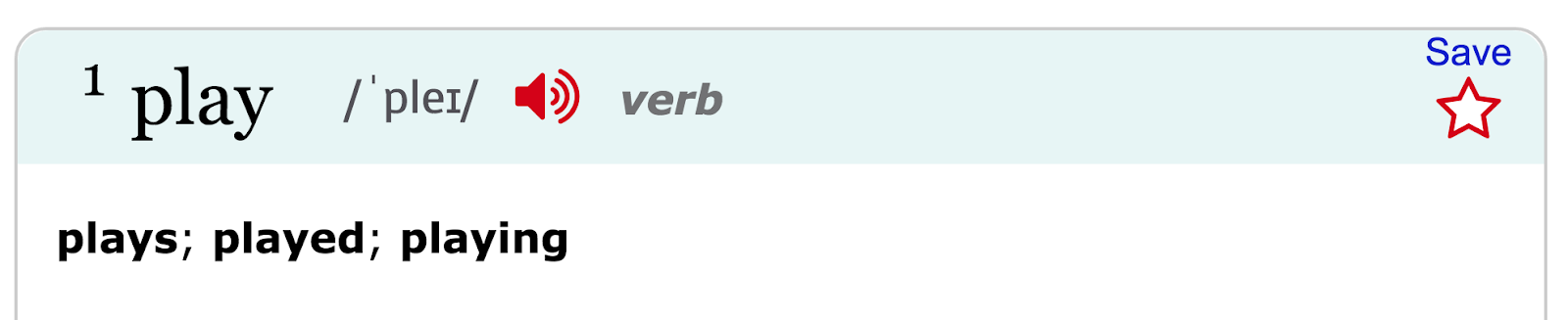

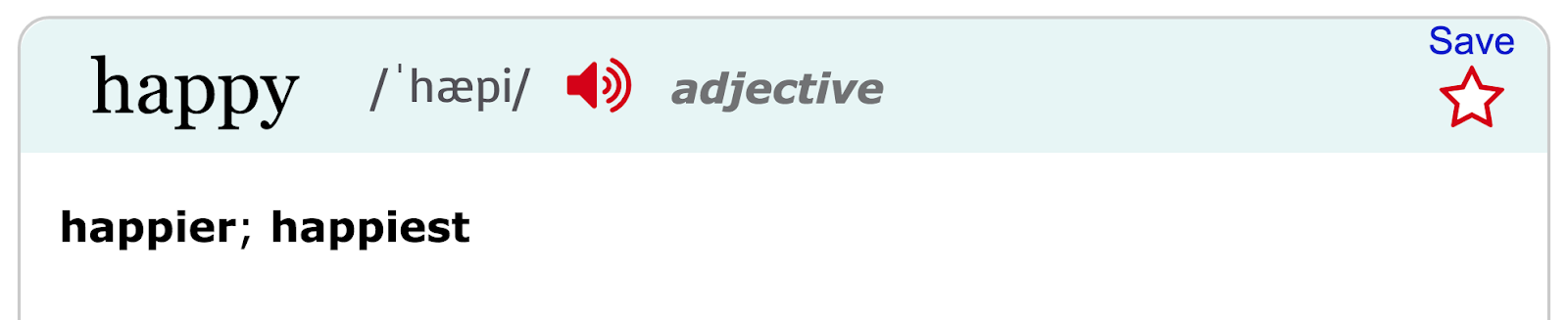
Figure 3: The upper screenshot shows the dictionary entry of the verb, play, with different tenses. The middle screenshot shows the dictionary entry of the noun, play, with its plural form. The bottom screenshot shows the dictionary entry of the adjective, happy, with its comparative and superlative degree.
Third, each definition provides information and examples of whether a verb is used as a transitive verb or not, or how a noun is used as countable or non-countable. This could definitely assist you in deciding whether you should use the word in one form or the other (see Figure 4).
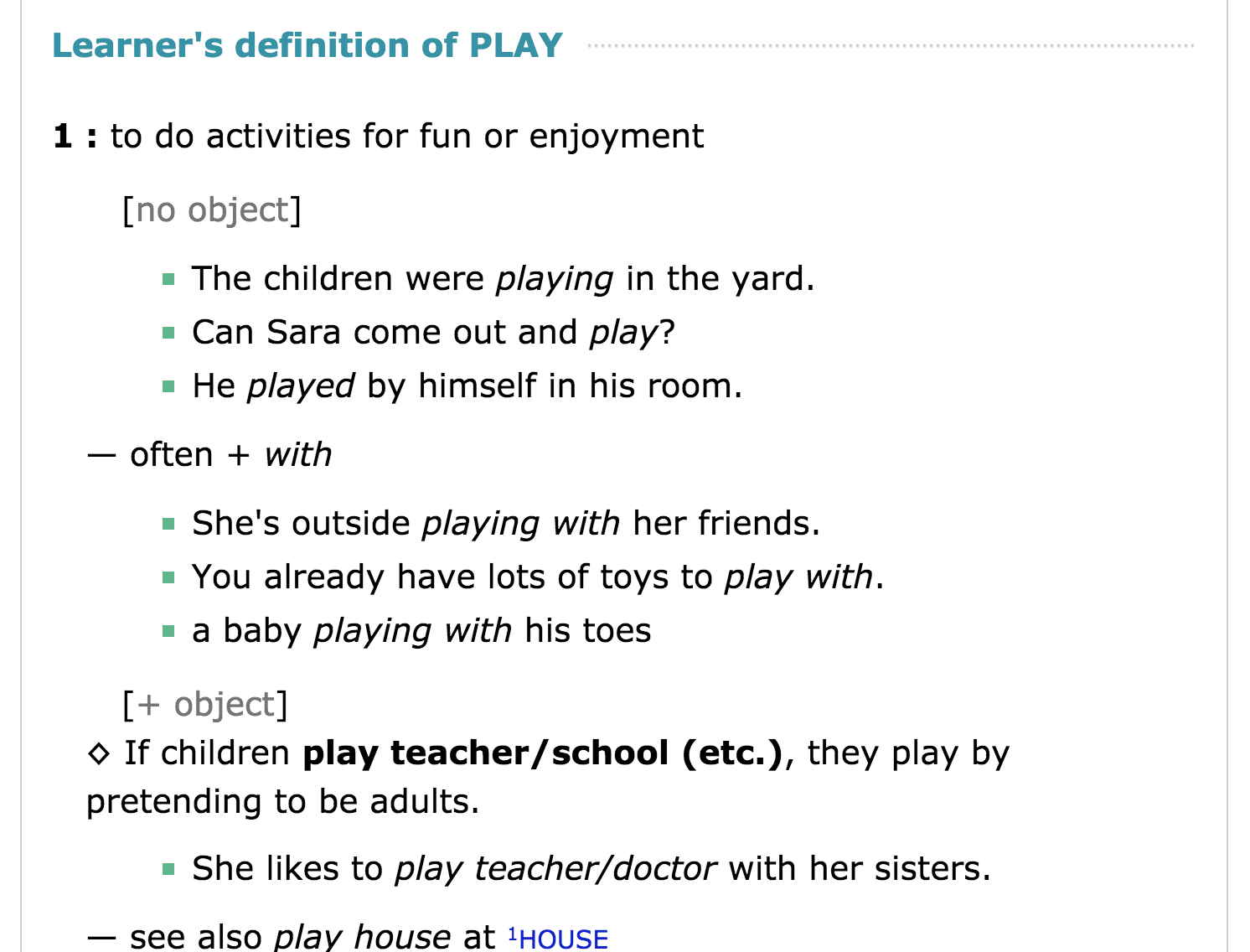
Figure 4: An entry of the verb, play, which demonstrates how to use it as an intransitive verb (no object) or a transitive verb (+ object).
Fourth, the dictionary provides some phrases that include the word you are looking for, which allows you to quickly understand how the word is used together with other words. For instance, ‘play (someone) for (something)’ for the word ‘play’ (see Figure 5). This feature makes it really useful for ESL learners to learn about regular words (in the sense that it is relatively basic and is commonly used). The database of Learner’s Dictionary probably contains fewer words compared to the regular Merriam-Webster Dictionary (see review), but contains enough words for most of the words that ESL learners (e.g., me) need at the initial phase of their learning journey.

Figure 5: The screenshot shows the phrase, ‘play (someone) for (something)’, its definition, and usage example.
Interesting Features
Some additional features include 'saving' the word into your own list (required account login that is free to sign up) for you to return to later and you can comment or start a discussion at the end of the entry. You can also see other discussions within the community by clicking on the ‘Community’ tab.
On the right sidebar, the site also provides ‘word of the day’, ‘Quiz’, ‘Visual Quiz.’ These sections provide a way for you to engage with new words or test your vocabulary if you are up for it. The ‘Ask the editor’ section will provide you with an article written by the editor in response to users’ questions about language usage (see Figure 6).
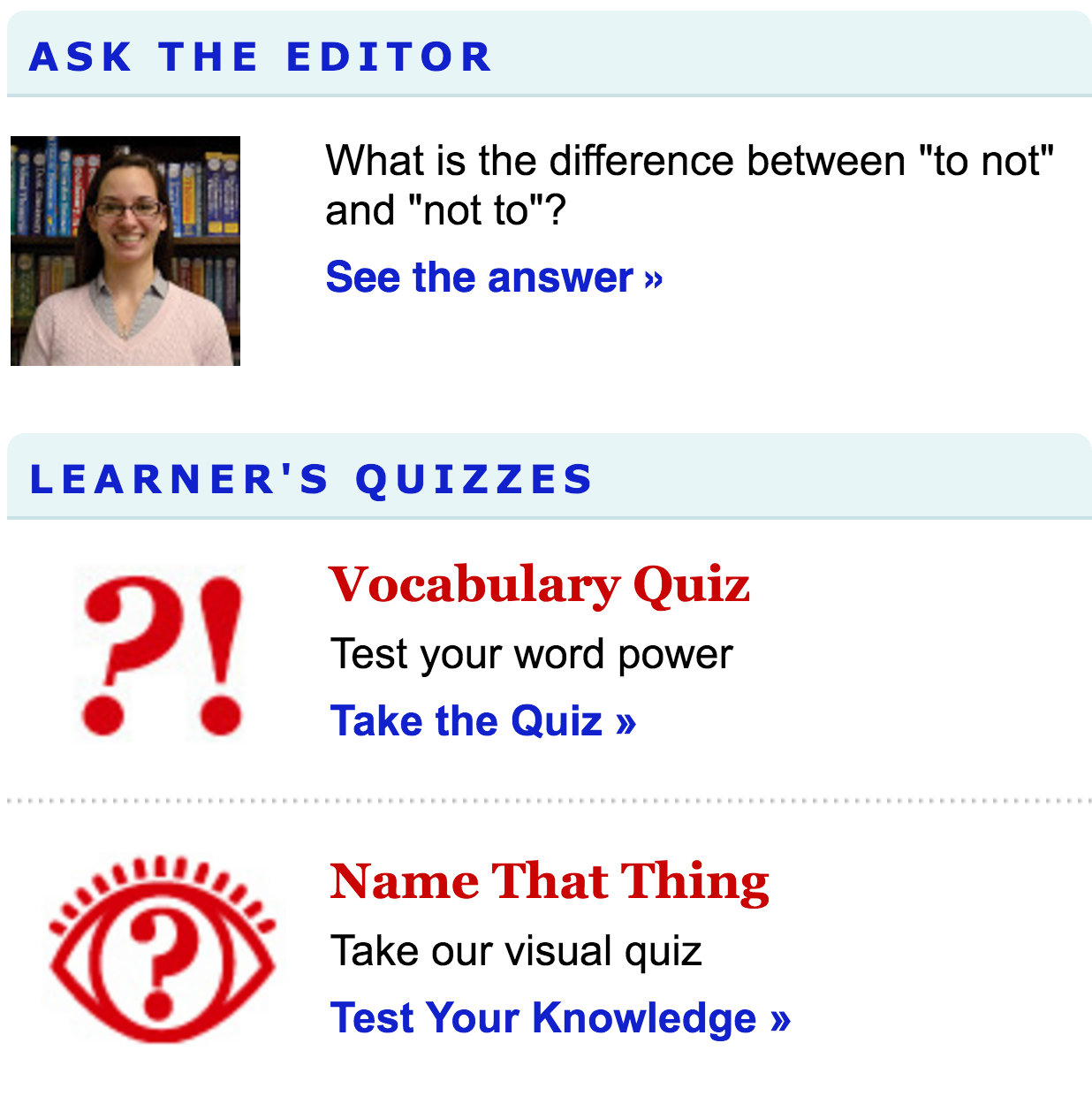
Figure 6: Features on the sidebar such as ‘Ask the Editor’ or ‘Learner’s Quizzes.’
Credibility
The content on this site is considered authoritative as it is produced by Merriam-Webster, the company that produces the Encyclopedia Britannica. The definition provided by the company’s regular dictionary, Merriam-Webster Dictionary (see review), is occasionally cited by researchers in my field when they need to define a word or explain how a concept has evolved from the early dictionary definition to a more contemporary academic interpretation.
Note:
- All the screenshots are taken on Merriam-Webster’s LearnersDictionary.com.
- This work is an extension of a course project for ELI 510 offered by the English Language Institute at the University of Michigan.
- Thanks to my former instructor, Pamela Bogart, who has kindly provided feedback and has helped me edit this review.